A perfume production timeline quoted as a single number hides the fact that six distinct stages sit inside it, and that two of them decide almost everything. Compounding, resting, filtration and bulk release, filling and crimping, and final documentation each consume time for a different reason, and only resting and the tail of documentation are genuinely difficult to compress. An established beauty brand planning a launch should therefore refuse the single number and ask for the stage sequence, because the stage sequence is where the controllable portion of the calendar lives. Once the sequence is visible, most schedule arguments turn into specific questions about one stage rather than a general negotiation about lead time.
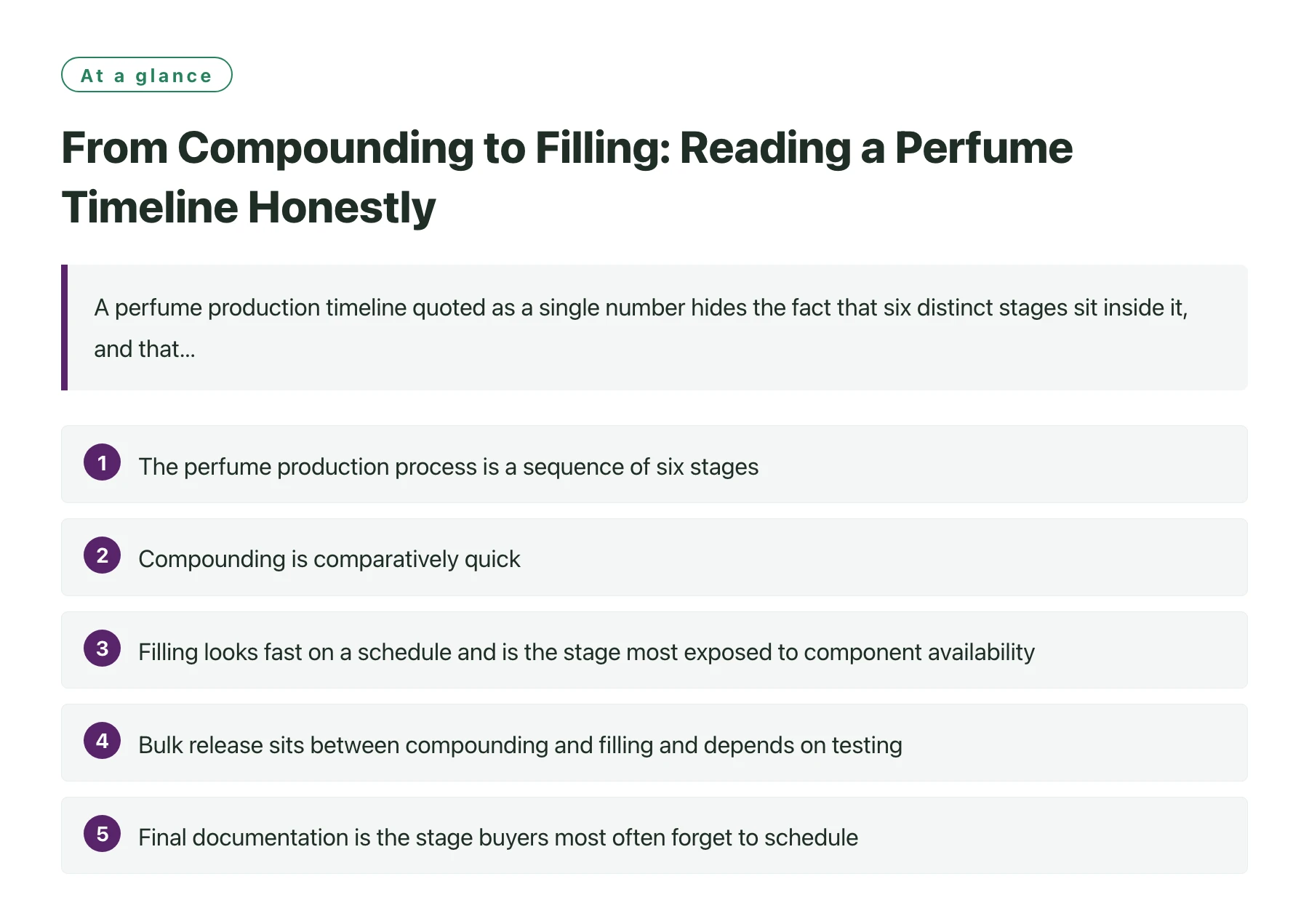
Key takeawaysThe perfume production process is a sequence of six stages, and treating it as one opaque lead time makes every delay look like the factory's fault and every acceleration look impossible. · Compounding is comparatively quick; resting after compounding is the least compressible stage because it is a matter of the material settling rather than of capacity. · Filling looks fast on a schedule and is the stage most exposed to component availability, since bottle, pump, closure and liner must all be present and compatible. · Bulk release sits between compounding and filling and depends on testing, so a formula change late in development pushes the whole tail of the calendar. · Final documentation is the stage buyers most often forget to schedule, even though it typically gates the shipment rather than following it. · A brand that asks which stage is the critical path, and what would have to be true for it to move, learns more than it does from any quoted total.
Production planning conversations go wrong in a predictable way. The brand asks how long a run takes, the supplier answers with a number that turns out to have been measured from a different starting point, and the disagreement surfaces only when a launch date is at risk. Both parties were describing real experience; they were describing different stages.
This stage-by-stage walkthrough is written from the perspective of a production planner who has had to explain to a marketing team why the run was two weeks from finishing when the shipment was already overdue. It covers what actually happens between a locked formula and a sealed bottle, and it identifies which parts of that journey respond to planning and which do not.
Two constraints shape everything below. The first is that a fragrance is a mixture that keeps changing after it is made, which is why resting exists. The second is that filling is an assembly operation, so it is limited by whichever component arrives last.
The six stages between a locked formula and a sealed bottle
- Formula lock and specification releaseThe formula stops changing and a dated specification becomes the controlling document. Any change after this point is a revision with a cost, which is why the release date matters more than it appears to.
- Bulk compoundingMaterials are weighed and mixed to the specification. Technically this is a short stage, and it is also the one where a late material substitution becomes visible, because the batch record will show it.
- Resting after compoundingThe bulk is held so that the mixture settles before it is evaluated and filled. This is the least compressible stage in the sequence, because it is governed by the behaviour of the materials rather than by production capacity.
- Filtration and bulk releaseThe rested bulk is filtered and released against its specification, which is where testing sits. A marginal result here does not merely delay a batch; it can send the formula back a stage.
- Filling and crimpingBulk meets packaging. Every component has to be present, dimensionally correct and compatible, and the decorative work on the bottle has to be finished before this point rather than alongside it.
- Final checks, documentation and packingFinished goods are checked against the approved reference, the batch documentation is completed, and the consignment is packed. This stage is frequently treated as administration and frequently gates the ship date.
Read as a sequence, the perfume production process begins to explain itself. Compounding is a production task, resting is a physical process, filling is an assembly task and the final stage is a documentation task. Each responds to a different kind of management, and only one of them can be accelerated by adding people. That is why a brand that wants to move a date should first establish which stage it is asking to move.
Where the calendar actually goes
Two stages absorb most of the elapsed time and most of the risk. Resting is the first: it cannot be shortened by scheduling, only by starting earlier, and its length depends on the materials in the formula rather than on the factory's workload. The second is the tail, meaning bulk release and the final documentation, because both depend on information being complete rather than on machines being available.
Everything else behaves more like ordinary production. Compounding is quick, and filling is quick in proportion to how well the upstream stages and the packaging supply were prepared. The practical implication is that a brand should stop negotiating the total and start asking which stage is on the critical path, because the answer tells it where its own preparation has the most leverage.
Why resting cannot simply be skipped
A freshly compounded fragrance is not yet the fragrance the consumer will meet. The mixture continues to change as its components interact, which is why formulations are rested before they are assessed and filled. Volatile materials behave differently over hours and days, and the chemistry behind that behaviour is well documented in the general literature on aroma compounds [1].
For an established beauty brand the consequence is a planning rule: the approved sample is a reference for a rested material, so the bulk should be evaluated at a comparable point rather than immediately after compounding. Comparing an unrested bulk against a rested reference creates the appearance of a problem where none exists, and it can trigger an unnecessary revision.
What the brand controls in this sequence
The brand controls three of the six stages without owning a single piece of equipment. It controls how quickly artwork and packaging specifications are frozen, how quickly a sample is approved against a retained reference, and how quickly documentation queries are answered. Those three decisions sit at the two ends of the sequence and are the most common cause of slips that nobody initially attributes to the brand.
Formulation and testing practice for this kind of work is covered in the technical literature for cosmetic and fragrance developers, and it consistently treats the assessment point as part of the specification rather than as a matter of preference [2].
There is also a straightforward commercial use for this map. Where a brand is buying fragrance development and manufacturing as separate services, it should confirm that the resting and release stages are owned by one party rather than shared, because a handover in the middle of the sequence is where a week quietly disappears. When those stages sit with a single supplier, the handover disappears, and understanding what their OEM/ODM manufacturing services cover becomes the fastest way to know who owns the critical path.
A workable planning habit: build the schedule backwards from the ship date through the six stages, then mark which stage the brand itself is waiting on. If the answer is none of them, the plan is probably optimistic. Brand-side delays are also the easiest to fix, because they usually require a decision rather than a resource. Where a sample and a bulk order diverge in character, the reason is usually the assessment point rather than the formula, and the mechanics behind why a sample and the bulk order can differ are worth understanding before the next revision is requested.
Sources
- Chemistry World (Royal Society of Chemistry) —— The Royal Society of Chemistry's magazine, covering chemistry research and explanations of everyday materials including aroma compounds.
- Cosmetics & Toiletries —— A technical magazine for cosmetic formulators, covering ingredients, formulation science and testing methods.
Frequently asked questions
What are the stages of the perfume production process?
Formula lock and specification release, bulk compounding, resting, filtration and bulk release, filling and crimping, and final checks with documentation and packing. Two of those stages, resting and the release-and-documentation tail, usually decide the elapsed time.
Which stage of perfume production takes the longest?
Resting after compounding is the least compressible stage, because it is governed by how the materials settle rather than by production capacity. The release and documentation tail is the second largest consumer of time and is more dependent on information being complete.
Can resting time be shortened to meet a deadline?
It can be started earlier but not compressed by scheduling. Shortening it risks filling a mixture that has not yet reached the state the approved sample represented, which is how a bulk order ends up smelling different from the reference.
Why is filling often the stage that slips?
Because filling is an assembly operation. It requires the bulk, the bottle, the pump or cap, the liner and any decorated components to be present, correct and compatible at the same time, so a delay in any one of them stops the whole stage.
What can a brand do to protect the schedule?
Freeze artwork and packaging specifications early, approve samples against a retained reference rather than from memory, and answer documentation queries quickly. Those three brand-side decisions affect both ends of the sequence and are the most common preventable causes of delay.