A machinery supplier should be assessed against the exact machine, process, and delivery conditions in a purchase—not against a polished catalog or a single certificate. A useful review connects documents to observable production evidence, then records what still needs to be verified before an order is placed.
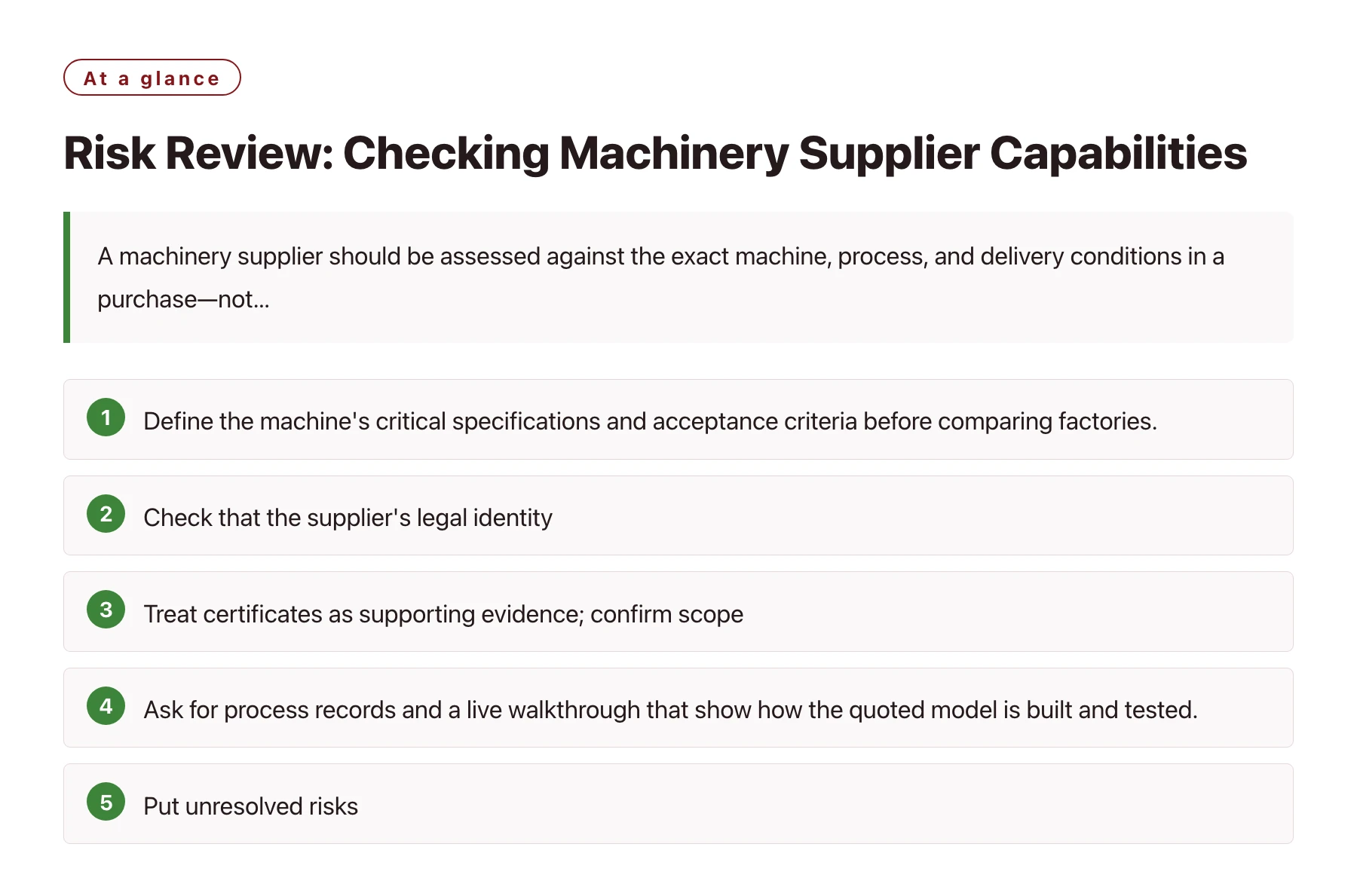
Key takeaways
- Define the machine's critical specifications and acceptance criteria before comparing factories.
- Check that the supplier's legal identity, factory address, and quoted contracting entity align.
- Treat certificates as supporting evidence; confirm scope, issuer, validity, and relevance to the product.
- Ask for process records and a live walkthrough that show how the quoted model is built and tested.
- Put unresolved risks, inspection stages, documentation, and remedies into the purchase contract.
Machinery purchases combine technical fit with operational risk. A machine can match a brochure description and still fail a buyer's needs because its duty cycle, electrical configuration, guarding, tooling, software, spare-parts package, or acceptance test was never specified. Supplier review is therefore not a search for a universally 'best' factory. It is a structured check of whether a particular supplier can make, document, test, and support the equipment described in the order.
Turn the requirement into a reviewable specification
Before contacting factories, separate essential requirements from preferences. Identify the intended material, output range, operating hours, accuracy or tolerance needs, available floor space, utilities, safety conditions, and applicable market requirements. For a machine with options, state the exact configuration: model, motor and voltage, control system, tooling, guarding, accessories, and included software. A request such as 'industrial grade' cannot be tested; a measurable requirement can.
Define how acceptance will be demonstrated. Depending on the equipment, that might include dimensional checks, a sample run, a load test, cycle-time observation, alarm and safety checks, or a review of calibration and test records. The method should match the risk. A cosmetic check cannot establish machine accuracy, and a brief no-load demonstration cannot establish performance under the buyer's intended conditions.
Keep a requirements matrix with each item, the evidence requested, the person responsible for review, and the point at which it must be confirmed.
Verify who will make and contract for the machine
Ask for the supplier's full legal name, registration details, operating address, and the name of the entity that will sign the contract and receive payment. Compare those details across the quotation, business documents, bank instructions, and factory address. A mismatch does not automatically prove a problem: a trading company may coordinate production at a separate factory. It does mean that the roles, quality responsibilities, and payment relationship need to be explained in writing.
Then establish whether the proposed production site has experience with the relevant machine category and configuration. Request a process map or a plain-language description of which operations are performed in-house and which are outsourced. For critical components, identify the source, inspection responsibility, and how a change of supplier would be approved. If the seller cannot answer a technical question immediately, record it as open and agree on a response date rather than treating confidence as evidence.
Read certificates in context
A quality-management certificate can indicate that an organization has a documented system within a stated scope, but it does not certify that every machine will meet a particular buyer's specification. ISO describes ISO 9001 as requirements for an organization's quality management system and explains that the standard does not prescribe a single way for an organization to operate.[1] The practical question is whether the supplier's documented controls cover the site and activities involved in this order.
Check the legal entity, site, scope, issue and expiry dates, and certification body shown on the document. Where the stakes justify it, validate the certificate with the issuer or its public directory. Ask how the supplier controls drawings, revisions, incoming materials, nonconforming parts, calibration, final testing, and corrective actions. A certificate should prompt specific questions; it should not substitute for the answers.
For machinery placed on a regulated market, identify product-specific legal requirements separately. A management-system certificate is not a substitute for product conformity documentation, technical files, or required testing.
Look for evidence from the actual production process
Request evidence that maps directly to the quotation: a current drawing or bill of materials for the offered configuration, sample inspection records, test procedures, equipment calibration records where relevant, and examples of how defects are contained and corrected. Protect confidential information and customer identities; the supplier may be able to provide redacted examples or demonstrate the process on a live call.
A factory walkthrough is more useful when it follows the process from incoming parts through assembly, inspection, packing, and dispatch. Ask the supplier to show the station or record that answers each critical question. Confirm that the demonstration concerns the proposed site and product family. If a key component is outsourced, request the control plan for that supplier and the incoming checks performed when the part arrives.
Distinguish what can be verified remotely from what requires a sample or on-site inspection. Photos can document visible conditions at a moment in time, but they do not establish machine performance or prove that the pictured item is the one that will ship. For higher-consequence purchases, agree on inspection access, sampling rules, test conditions, and the treatment of failures before production reaches its final stage.
Make delivery and acceptance part of the capability review
A capable supplier must be able to deliver the complete order in a condition the buyer can receive, install, and use. Review the proposed lead time against the production steps, long-lead components, testing, packing, and export preparation. Ask which milestones will be reported and how schedule changes will be raised. Confirm the spare-parts list, operating and maintenance manuals, wiring diagrams, language requirements, and packaging method that the machine needs for transport and storage.
If the goods are imported into the United States, the importer remains responsible for reasonable care in the entry process; U.S. Customs and Border Protection's importer guidance discusses the information importers should understand and keep for a transaction.[2] Buyers in other markets should confirm local customs, product-safety, and documentation requirements with the relevant authorities or qualified advisers. Do not assume the factory's shipping quotation includes every destination-side charge or compliance task.
Write the acceptance method, inspection access, document list, packing requirements, shipment milestones, and remedies for material nonconformity into the contract or its appendices. For key terms, specify an owner and a deadline. A verbal assurance made during evaluation is difficult to enforce if the final order does not capture it.
Use a decision record instead of a single score
A simple scorecard can organize the review, but a total score should not hide a critical gap. Track technical fit, identity and site verification, process evidence, testing, documentation, delivery assumptions, and service support as separate topics. Mark each item as verified, open, or not applicable, and attach the evidence or meeting note behind the status. If a requirement is a condition of safe operation or legal sale, treat it as a gate instead of allowing a strong score elsewhere to compensate for missing proof.
When comparing suppliers, use the same requirements and evidence requests for each candidate. Record where quotations differ, including what is excluded. If the preferred offer is unclear on configuration, test conditions, or responsibility for outsourced work, clarify it before comparing price. A lower initial quote may describe a different scope, so the decision should compare equivalent machines and obligations.
For teams coordinating overseas sourcing, a local sourcing partner can help organize supplier communication, document collection, factory visits, and inspection scheduling. Buyers can review the scope of JS Sourcing support against their own procurement plan and keep technical approval, contract decisions, and product acceptance tied to named responsibilities.
Sources
Frequently asked questions
Does an ISO 9001 certificate prove that a machine is compliant?
No. ISO 9001 addresses an organization’s quality-management system, not the conformity of a particular machine. Buyers still need product-specific safety, testing, and market documentation for the exact configuration.
Should a buyer visit the factory before placing an order?
It depends on the value, technical complexity, and consequences of failure. A visit or independent inspection is more useful when it follows defined questions and acceptance criteria.
What is the most important supplier document to request?
There is no single document that establishes capability. Start with the exact configuration and acceptance criteria, then request evidence that addresses each critical requirement.
Can a trading company be a suitable supplier?
It may be, if its role, production site, quality responsibilities, contract obligations, and payment relationship are transparent and acceptable to the buyer.